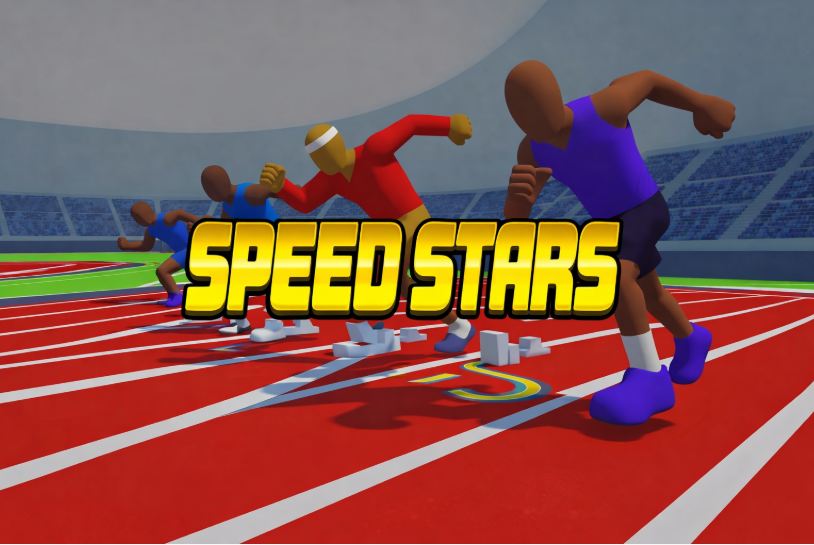
Speed Stars Review: Why I Keep Running the Same 100 Meters
I’m not normally interested in shaving tiny fractions of a second from a score. If a game tells me I finished in 10.24 seconds, that sounds perfectly respectable. I completed the task, nobody got hurt, and we can all go home.
Speed Stars changed me.
Now I see 10.24 and wonder whether 10.19 is possible. I adjust my tapping rhythm, restart the race, and watch my digital athlete wobble through the first few steps like a newborn giraffe. One more attempt, I tell myself. Then another. Somewhere along the way, a simple running game becomes a personal argument with a stopwatch.
Speed Stars is a physics-based track and field game developed by Luke Doukakis. Its central idea is beautifully compact: alternate between two controls to move your runner’s legs. You don’t guide the athlete with a traditional directional stick. Instead, you create a stride through timing and rhythm.
That system takes seconds to understand and considerably longer to control.
What Makes Speed Stars So Addictive?
Most sports games give players dozens of systems to manage. Speed Stars gives you a lane and asks whether your fingers can maintain a beat.
Each alternating input produces a step. When your timing is balanced, the athlete accelerates smoothly and runs with convincing momentum. When the inputs become uneven, the running form deteriorates. You lose speed, stumble, or finish with a time that makes you question whether the runner stopped to answer a phone call.
The game works because improvement feels personal. You don’t win by finding a more powerful vehicle or equipping a rare item. Your performance changes because your rhythm improves.
The official Speed Stars mobile listing describes a game built around two-finger touch controls, personal records, global rankings, ghost races, AI opponents, and replay cameras. The full version adds events beyond the basic 100m sprint, including the 60m, 200m, 400m, 110m hurdles, and 400m hurdles.
Available events and features can vary across browser, mobile, and PC releases, so check the version you’re playing before assuming every mode is included.
My First Runs Were Awful
I began by tapping as quickly as possible. That seemed logical. Running is about moving your legs quickly, so faster fingers should create a faster athlete.
No.
Speed Stars cares about the space between inputs. If one finger taps rapidly while the other arrives late, the runner loses balance and efficiency. You need a consistent left-right pattern, not random speed.
New players should forget about winning their first few races. Use those attempts to find a comfortable rhythm. Keep your fingers relaxed and listen to the sound of your taps. An even beat is easier to repeat than a frantic burst.
You should also avoid pressing harder when the athlete falls behind. Phones, keyboards, and controllers don’t reward emotional intensity. A furious tap does the same job as a controlled one, except it makes your hands tired sooner.
Start at a manageable pace, keep the alternation clean, and gradually increase the frequency. You’ll notice the runner’s movement becoming smoother before the stopwatch shows a dramatic improvement.
That visual feedback is one of the game’s best teaching tools.

The Start Deserves Its Own Practice
A good sprint begins at the signal, not five steps later. Speed Stars makes the opening moments important because a slow or messy start can ruin an otherwise strong run.
Wait for the starting cue and react without panicking. Players who focus entirely on reaction speed often begin with an uncontrolled sequence. They leave the blocks quickly, then lose rhythm almost immediately.
I’d rather sacrifice a tiny amount of reaction time and establish a stable stride. Once the pattern feels secure, push the tempo and build speed.
Practice the first ten meters separately in your mind. If the opening feels wrong, finish the race anyway and use the remainder to work on cadence. Constantly restarting after one imperfect step can become frustrating, and you’ll miss opportunities to practice the later section.
Returning players can compare their start against a personal ghost. If the ghost gains distance immediately but you match its speed afterward, your reaction or acceleration needs attention. If you begin together and fall behind near the finish, your maximum cadence or consistency is the larger issue.
Different Events Require Different Personalities
The 60m and 100m sprints are impatient events. They reward sharp reactions, fast acceleration, and a rhythm you can maintain at high speed for a short period. There isn’t much time to recover from an error.
The 200m and 400m ask for more restraint. Longer races punish players who attack the controls at maximum speed from the beginning. You need to manage effort, remain composed, and preserve enough consistency for the final section.
I enjoy the 100m most because it delivers the cleanest version of Speed Stars. The event is short enough to repeat immediately but long enough for small rhythm changes to affect the result.
The 400m is where the game exposes my impatience. I start with the confidence of someone who has developed a brilliant plan, push too hard, and spend the final stretch watching the athlete pay for my decisions.
Experienced players should develop a separate cadence for every distance. Don’t treat the 400m as four consecutive 100m sprints. A sustainable rhythm that finishes strongly will usually outperform an explosive opening followed by a collapse.
Hurdle events introduce another demand: you must coordinate forward rhythm with the timing required to clear obstacles. Beginners should become comfortable with ordinary sprinting first. Adding hurdles before you can maintain a stable stride is like learning to juggle while riding a bicycle. Ambitious, yes. Efficient, not particularly.
Ghost Racing Makes Failure Useful
Speed Stars lets you compete against recorded performances. You may face your own personal-best ghost, other players’ ghosts, or AI runners. This gives each attempt a visible target without requiring everyone to be online at the same moment.
Racing your personal ghost is particularly useful. It shows exactly where the better run gained time. Maybe your current start was faster, but your cadence weakened halfway through. Perhaps you lost ground early and recovered once you reached top speed.
Try not to watch the ghost constantly during the race. I’ve done that, and it usually causes my rhythm to unravel. Concentrate on your own inputs, then study the difference through the result or replay.
Replays make tiny errors easier to recognize. The problem may not be that you need “more speed.” You might need a cleaner transition out of the start, a more even middle section, or a less desperate finish.
That level of feedback gives Speed Stars surprising depth. Every race is short, but every race contains something to examine.
Characters and Customization
The game allows you to create and customize runners, with different versions offering choices for appearance, clothing, colors, stadium themes, music, and camera perspectives. Unlockable athletes can also have slight differences in performance.
I like that the character system adds variety without replacing the importance of player skill. A runner may suit a particular event or tapping style, but no character can rescue completely broken timing.
Regular players should test different athletes rather than choosing purely by appearance. One may feel more natural during acceleration, while another fits the cadence you use in longer events. The differences aren’t an excuse to ignore technique, but they can influence how comfortable a run feels.
Of course, if two characters perform similarly, I’m choosing the one with the better outfit. We all have priorities.
The Frustrating Side of Speed Stars
Speed Stars is repetitive by design. You will run the same distance many times, often trying to improve by less than a tenth of a second. Players who need new scenery, constant rewards, or a story campaign may lose interest quickly.
The controls can also feel awkward during the first session. Because the system is unusual, failure may appear random until you learn to recognize uneven timing. The game becomes far more satisfying once that relationship is clear.
Physical fatigue is another concern. Repeated rapid tapping can strain your fingers or wrists, particularly during long sessions. Take breaks, keep your hands relaxed, and remember that hitting the screen harder doesn’t make the athlete run faster.
Finally, content differs by platform and purchase level. Some releases provide a limited event selection before you unlock or buy the full experience. That’s worth checking if you want specific races such as the 400m hurdles.
Is Speed Stars Worth Playing?
Speed Stars is worth trying if you enjoy games built around mechanical improvement. It offers quick races, immediate feedback, and one of those rare control systems that feels silly at first and natural after enough practice.
New players should focus on even inputs, a controlled start, and relaxed hands. Experienced players can study ghosts, analyze replays, refine pacing for each distance, test different runners, and chase leaderboard positions.
I appreciate that a race lasting around ten seconds can hold so many small decisions. The gap between an average run and a personal best may come from one cleaner start or a few perfectly spaced inputs near the finish.
You probably won’t notice that difference from across the room. The stopwatch notices.
Honestly, that’s enough to make you press Restart.
Comments are Closed